Statiqbloom
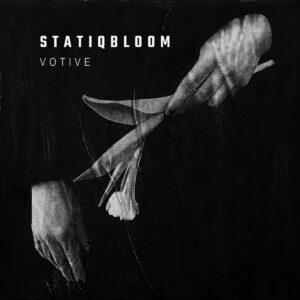
Votive
Phage Tapes
The rapidfire release schedule that has defined the recent years of Fade Kainer’s work in Statiqbloom has allowed for a lot of stylistic exploration, much of which was summarized on his Summer 2026 LP Splintered Fingers. The three tracks on Votive aren’t far off from that record’s broad remit of industrial techno, dark ambient texture, and swirling psychedelic electro-industrial, but does zero in on the sort of dripping, noisy material that defined some earlier eras of Kainer’s work. “Cut the Vine” revolves around thudding drums, swirling synth textures and enormous waves of reverb and delay, punctuated by bursts of percussion and Kainer’s own seething grown and anguished yells. It’s sound is immense, and is defined by the amount of space that still exists between each drum hit, each synth squelch, and makes a fine contrast to “Erased”, whose tense arrangement of percussion rarely relents just long enough to let you feel how claustrophobic it is, Kainer’s vocal presense kept to a low mutter or a distant shout, as if he’s trying to be heard from beneath the collapsing walls of saturated noise that pulse around the song’s rhythm. The brevity of closer “A Grief Observed” somehow makes it even more unnerving, the slow-motion chaos of it’s noisy sweeps, synthetic squeaks and murmured voices never quite coalescing and ending with an unsettling suddenness. For a short release, Statiqbloom certainly manages to cram in plenty of his signature rage and disquiet.
Nordvargr
Deathchamber
self-released
A trio of archival releases from Nordvargr, all released in the same week, all under different handles. That sort of cryptic productivity is par for the course for Henrik Björkk, naturally, who when he’s not working as part of Pouppée Fabrikk or Mz.412 has more solo projects than most artists have releases. Of these three records, the one released under his own handle, is likely the “purest” in terms of a roots, first wave industrial sound. While a pioneer in abrasive death industrial, the more classically brooding drones and rumbles of “Never Getting Out” are well within Nordvargr’s remit as well, and he’s able to give a relatively sparse number of core elements the right weight, dimension, and movement to create and establish fully fleshed out moods and keep just enough interplay and progression going. The lo-fi, right to tape sound without any mix or master and likely somewhat improvised interplay of hardware elements also works in the record’s favour; on the one hand the flavour of Deathchamber is that of a thrice-dubbed semi-anonymous release from the early 80s cassette underground, on the other Björkk himself was already such a seasoned hand at this sort of work when these sessions were put down in the early ’00s that his instincts regarding the peaks and valleys of drones and how much distant industrial percussion should be feathered in are spot on.