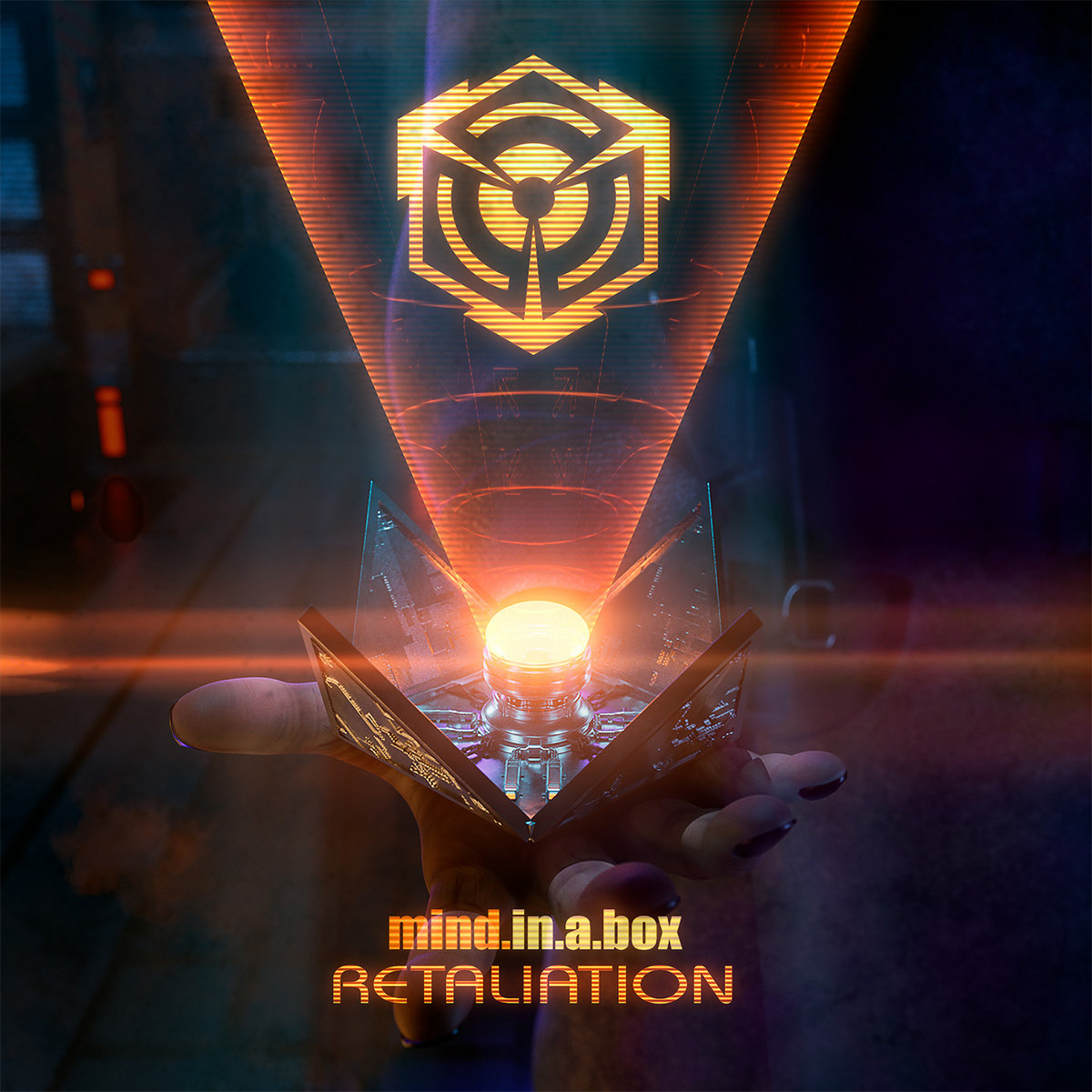
mind.in.a.box
Retaliation
THYX Records
The very first words you hear Stefan Poss sing in his signature manipulated and modulated style on synthpop act mind.in.a.box’s 9th LP Retaliation are “True freedom is the ability to think/while knowing your thoughts are your own”, and that carries a lot of baggage for the project in 2026. As a statement, it’s exactly what the conceptually driven band was founded on and is referenced in its very name, that our minds are trapped by systems of control and we need to free ourselves from them. It’s a pretty broad idea that has been at the heart of the band’s concept records since the beginning, informing its often vague, frequently impressionistic overarching narrative (a summary of whose characters, story events and interpretations thereof would take far more time and space than we have allotted for this review).
Where this gets more complicated is largely metatextual, and how you end up reading it will very likely depend on where the listener’s own politics lie. Briefly, almost a decade ago the band’s original lyricist and story designer Markus Hadwiger parted ways with m.i.a.b. and was replaced by Josh Kreger, who had previously worked with Poiss’ THYX side-project. Kreger’s style is significantly different from Hadwiger’s often abstract and emotional storytelling, and starting with Broken Legacies the mind.in.a.box narrative took on a different, more descriptive and less overtly character driven approach. And within that came a lot of lyrics that seemed to point explicitly to various libertarian if not outright right wing talking points, most obviously on 2023’s Black and White, where it was hard not to read anti-vaxx sentiment (informed by Poiss’ own public sentiments on the topic) amongst other things in its depicition of the science fictional world in which the band’s story takes place.
It’s important to note that the emotionally driven and obscure sentiment of the Hadwiger era meant you could project whatever you wanted onto mind.in.a.box’s message, which for most seemed to be the 90’s cyberpunk information-will-free-us-from-our-corporate-oppressors a la Hackers take. Then again, it’s just as easy to read the stirring anti-authoritarian sentiments of those records as validations of whatever flavour of 4chan conspiracy someone might subscribe to. By seemingly injecting political viewpoints that can be mapped onto specific modern conservative talking points, it’s going to change how listeners process the record. And at the risk of being defensive, those reading this who have already decided the author is some hysterical leftist seeing right-wing boogeymen in every shadow, essayist Emily Palmieri, who has written extensive analyses of mind.in.a.box, and whose politics lean conservative reached the same conclusion in a recent blog post.
So where does that leave us with regards to Retaliation? Putting aside the notion that it’s just a record and should be assessed solely on its musical merits, well, it’s complicated. There are moments on cuts like “Brother War” that are exactly what we’ve always enjoyed from mind.in.a.box; soaring melodies, emotional lyrical delivery from Poiss in both his natural and electronically manipulated styles, and a complex evolving arrangement that allows for massive peaks and deep breakdowns, all rendered with impeccable sound design that recalls the height of millennial futurepop but with a modern production sensibility. And lyrically it’s easy enough to read its indictment of those who would violently turn us against each other as endorsable by anyone regardless of political alignment. Then again, once you hear it in the context of songs like “Agency of Agony” which features lines like “Taxing your life into infirmity” and the even more side-eye worthy couplets about a lack of “rationality” destroying “nationality”, it begs the question of who the author is encouraging the listener to rail against.
And to be clear, that’s unlikely to be a universal experience, regardless of the listener’s politics. The thing about this kind of coded but parseable messaging is that it leaves room for folks to take it or leave it. You can listen to Retaliation and never have to consider anything beyond it contextually, especially as it concerns its best cuts: “Stand and Rise” is one of the band’s best anthems in recent years, with twinkling arps, a driving synthwave rhythm and the expert production that gives substance and weight to every moment. And while it’s easy (especially for this writer, steeped in North American politics of the last decade) to liken the sentiment expressed in the lush closing ballad “Immunity” to the phenomenon of right wing agitators pivoting to appeals for us all to come together to “fight the real enemy” regardless of political alignment, it’s just as easy to take it at face value as a genuine call for unity in the face of a dark future. But that would seem to miss a large part of mind.in.a.box’s mission statement; since the beginning the band has always asked the listener to look beyond the surface of what they’re being told or asked to believe, see beyond binaries and make their own judgements, to formulate their own ideas and question their own biases. Whether or not you agree with any of the above, it would be hard to argue that Poiss and Kreger aren’t explicitly asking you to decide what it means for yourself. With regards to Retaliation, I would encourage those reading this to do the same.